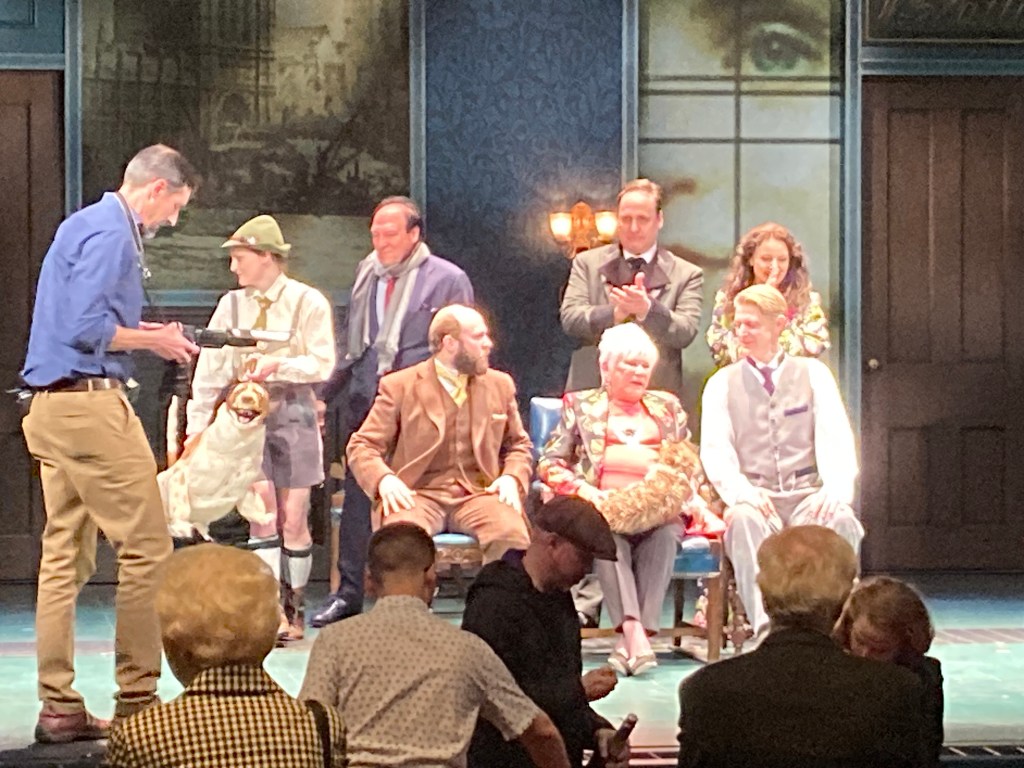
Watson comes on stage, but remains quiet as an unexpectedly tense scene unfolds behind the curtains. We watch the shadows of the characters and listen in on an interrogation. The cold open effectively sets the tone for the rest of the piece — Ken Ludwig’s humor is still in play, but this is a darker story than Baskerville.
Moriarty: A New Sherlock Holmes Adventure is currently premiering at the Cleveland Play House Allen Theatre until May 21, in Cleveland, Ohio.
It was hard to know how to begin this review, because, quite honestly, all I want to do is gush. The writing, the cast, the set, the music, the special effects — everything came together for an outstanding performance.
And after watching it on opening night, I decided to stick around the next day for the matinee. I will definitely watch this play again in the future, but never this particular production, and this absolutely magical cast.
I can’t recall the last time a Sherlockian adaptation made me feel so much. I laughed; I was scared; I cried. It gave me the full emotional rollercoaster experience in a way that very few Sherlockian adaptations have managed to do.
Sherlock Holmes is not often put in personal danger — even in adaptations of “The Final Problem,” there’s an expectation that everything will turn out right in the end. Moriarty will be vanquished, and Holmes will eventually return to Baker Street. All will be right with the world.
It’s powerful storytelling if an adaptation challenges that expectation of safety. And as the play goes on, you find that you can no longer take anyone’s safety for granted.
So let’s talk about the plot. It’s been pretty well-publicized that the story blends “A Scandal in Bohemia,” “The Final Problem,” and “The Bruce-Partington Plans.” But anyone who is also familiar with William Gillette’s seminal play, Sherlock Holmes: The Strange Case of Miss Alice Faulkner, will recognize some elements from that play (which is itself a blending of SCAN and FINA). Ludwig weaves these stories together expertly, and in such a way that you don’t quite know what’s coming next.
Professor Moriarty does not appear himself until after the intermission, but his voice is used very effectively throughout Act One, casting a shadow over everything that’s happening. Jeff Bender’s Moriarty is scary in a way I’ve not seen since Jared Harris. This production said, “Let’s take the Professor seriously and make him terrifying,” and they delivered. He is egotistical but justifiably so — intelligent, cunning, cruel, and deadly.
(A note to Moran fans: while the Colonel does not appear himself in the flesh, he is nevertheless part of the story, and we are powerfully reminded of why Holmes fears airguns in the opening of FINA.)

Sherlock Holmes, played by Christian Pedersen, is anything but cold and calculating. Of course, he’s still clever, still brilliant — but this is a Holmes who is haunted, a little bit broken, and once he explains why, it makes all the sense in the world. This is also a Holmes with a strong moral compass, driven to right wrongs and seek justice. He finds himself on the wrong foot a few times, but always manages to course-correct. Several of the roles in the play are very physical due to the fight sequences, but Christian’s Holmes has a physicality that goes beyond that, rather reminiscent of Jeremy Brett.
Nick Gaswirth takes on Dr. John H. Watson. If you’ve seen Baskerville, this is the same Watson (whether or not the two plays take place in the same universe). Watson is enthusiastic and kind, and a very good person overall, and there’s a real chemistry between Nick and Christian. Here dwell together still two men of note, and they are truly the best of friends.
Olivia Gilliatt is one of the three actors to play multiple roles, although she only plays Mrs. Hudson, the Baker Street Irregular Cartwright, and Irene Adler. And it’s on Irene that I want to dwell. Irene Adler has been entangled with Professor Moriarty in some odd ways in recent history. This time, her involvement, such as it is, is fresh and exciting. This Irene is no cat burglar or criminal — she emerges as a heroine in her own right, clever and passionate and full of her own agency.
(And her interaction with Mycroft Holmes is something I never knew I needed ‘til I saw it!)
Jeff Bender takes on two more major characters, aside from Moriarty: Mycroft and Lestrade. Lestrade is amusingly obnoxious, generating some much-needed laughs after an unexpected turn in the story. Mycroft, on the other hand, is probably the most delightful version of the character since Charles Gray (and I say that as a Mark Gatiss fan!).
Talley Gale rounds out the cast with a wide assortment of characters, from the maid Daisy to the hilariously unhinged Hilda Klebb to Milker, another of the Baker Street Irregulars. And she is the puppeteer for and voice of Toby! Gale and Bender both have to do the lion’s share of role- and costume-switching, and they do it with aplomb.
Christopher Morley once called the Sherlock Holmes Canon a “textbook of friendship,” and indeed, I love it when relationships are an underlying theme in adaptations and pastiche. Moriarty is really a story about relationships: Holmes’s relationship with Watson, his relationship with Moriarty, and his relationship with Irene — I could mention others, but that would veer into spoilery territory. Suffice it to say that it is a very moving and emotional piece in the midst of all the adventure, and it all works. It all makes sense and feels natural. (Sherlock Holmes in New York, eat your heart out.)
At this point, I should give a shout-out to the brilliant music and sound design by Lindsay Jones. What I wouldn’t give for a soundtrack for this play! And the set, designed by Chika Shimizu, is gorgeous. (And I got to tell her so!)

In the end, I can really see this play going on to be a Sherlockian classic. The story is engaging, and the characters are strong — you just need the right production crew and cast to do it all justice. That’s certainly what Moriarty got in its world premiere, and I feel very lucky to have seen it! (Especially on opening night, in a theatre with other Sherlockians. That was magical, particularly when Peter Blau’s name came up in the dialogue!)
If you are able to, get out to Cleveland to see this production before it’s over! If you can’t, watch it as soon as it’s local. You won’t regret it.
I am still in love with it. Moriarty is just as good as if not better than any Sherlockian movie I’ve seen — and some of you may know how much I love Murder by Decree. I expected to enjoy myself immensely; I didn’t expect to fall in love.
I can’t wait to watch it again.
Speaking of watching things, remember to watch this space for podcast episodes involving the play!
 Dynamics of a Podcast
Thank you Madeline! We at Baker Street West and the Baker Street Players can’t wait to get our hands on Ken Ludwig’s new script. His ‘Baskerville’ has been a huge hit with our audiences. Your review, with it’s insights, has given me a vision of what ‘Moriarty’ has in store for the rest of us Sherlockians and theatre geeks!
LikeLiked by 1 person
Oh, thank you, Beth! I appreciate that. I really look forward to seeing what you think about the play! There’s so much depth to it.
LikeLike